It’s one of the most common questions first-time visitors ask before heading to Glacier National Park: how long does Going-to-the-Sun Road actually take? The honest answer is that it depends entirely on what kind of trip you’re planning.
The road itself is 50 miles long. Without any stops, you can drive it end-to-end in about two hours.
But almost nobody does that- and almost nobody should. Going-to-the-Sun Road is lined with overlooks, trailheads, wildlife sightings, and some of the most spectacular scenery in North America. The real question isn’t how fast you can drive it – it’s how much time you want to spend on it.
Here’s a complete breakdown of how long Going-to-the-Sun Road takes depending on your plans, plus everything you need to know to make the most of every mile.
Quick Answer: Going-to-the-Sun Road Time Estimates
Here’s a simple snapshot before we dive into the detail:
| Trip type | Time needed | Best for |
| Drive-through only (no stops) | 2 hours | Return visitors, tight schedules |
| Drive with scenic pullout stops | 3–4 hours | First-timers wanting highlights |
| Half-day visit | 4–5 hours | Scenic stops + short Logan Pass walk |
| Full day | 6–8 hours | First-timers wanting the full experience |
| Full day with hiking | 8–10+ hours | Active visitors, hikers |
Our recommendation for first-time visitors: plan for a full day. You won’t regret the extra time, and you’ll almost certainly use it.
If You’re Just Driving Through: 2–3 Hours
The 50-mile route from the West Glacier entrance to the St. Mary entrance takes approximately 2 hours of pure driving time. In practice, expect closer to 3 hours even with minimal stops — the road is narrow and winding through the alpine section, with a posted speed limit of 25–45 mph depending on the stretch, and traffic during peak season slows progress considerably.
A pure drive-through is a reasonable option if you’ve visited the park before and simply want to cross the Continental Divide, enjoy the views from your car window, or connect between the west and east sides of the park. It’s not the best way to experience the road for the first time.
What you’ll see on a drive-through:
- Lake McDonald — the park’s largest lake, visible from the road on the lower west side
- McDonald Creek — runs alongside the road for several miles
- Weeping Wall — natural springs seeping through the rock face alongside the road
- Logan Pass — the summit at 6,646 feet; you can briefly stop at the visitor center
- Jackson Glacier Overlook — one of the few glaciers visible directly from the road
- Mary Lake — sweeping views as you descend toward the east entrance
With Scenic Stops: 3–5 Hours
Most casual visitors fall into this category. Plan for 3–5 hours if you want to make several stops at pull-offs and overlooks, spend 20–30 minutes at Logan Pass, and still have time to stretch your legs without committing to a hike.
Suggested stops and time estimates:
- Apgar Village (15–20 min) — visitor center, lakeside views, great starting point
- Lake McDonald shore (15–20 min) — colorful rocks, mountain reflections, iconic photo stop
- The Loop overlook (10 min) — dramatic hairpin turn with wide valley views
- Bird Woman Falls Overlook (10 min) — views of a 492-foot waterfall across the valley
- Weeping Wall (5–10 min) — natural springs spilling over the rock face; can be heavy in early season
- Logan Pass Visitor Center (30–45 min) — summit views, wildlife, short boardwalk stroll
- Jackson Glacier Overlook (10 min) — one of the last visible named glaciers from the road
- Wild Goose Island Overlook (10 min) — the most photographed spot in the park
Add those together and you’re looking at roughly 2–2.5 hours of stop time on top of 2–3 hours of drive time — landing squarely in the 4–5 hour range for a comfortable half-day trip.
Full Day on Going-to-the-Sun Road: 6–8 Hours
If this is your first time visiting Glacier National Park, block out a full day for Going-to-the-Sun Road. Six to eight hours gives you time to drive the whole route, stop at the main overlooks, spend a couple of hours at Logan Pass, have a lakeside picnic, and still feel like you haven’t rushed anything.
Sample full-day itinerary (west to east):
- 6:30–7:00 AM — Arrive at Apgar; grab a spot at Logan Pass before the lot fills
- 7:00–8:00 AM — Drive the lower west section to Lake McDonald; stop for photos at the lakeshore
- 8:00–10:30 AM — Continue up to Logan Pass; the lot is typically full by 9:30 AM on peak days
- 10:30 AM–12:30 PM — Explore Logan Pass: visitor center, meadow boardwalk, wildlife watching, Hidden Lake Overlook if you want a short hike
- 12:30–1:30 PM — Picnic at Logan Pass or descend to a pullout with views; pack lunch from a grocery store in Whitefish or Columbia Falls
- 1:30–3:00 PM — Drive the east side: Jackson Glacier Overlook, St. Mary Lake, Wild Goose Island
- 3:00–4:00 PM — Explore St. Mary area; optional: quick stop at St. Mary Falls (1.6 mi round trip)
- 4:00–5:30 PM — Return drive via Going-to-the-Sun Road or Highway 2 depending on your lodging
Driving east to west is also a perfectly good option — and some drivers prefer it because the upper alpine section keeps you closer to the rock wall rather than the road’s edge on the more exposed sections.
Full Day With Hiking: 8–10+ Hours
Add a hike or two and you’re easily looking at a 8–10 hour day. Several of Glacier’s best trails start directly off Going-to-the-Sun Road, making it easy to combine a scenic drive with a world-class hike without any extra driving.
Best hikes along the Going-to-the-Sun Road corridor:
- Trail of the Cedars (0.9 mi loop, easy) — flat old-growth cedar forest near Avalanche Creek; great for families; add 20–30 min
- Avalanche Lake (4.4 mi round trip, moderate) — stunning glacial lake at the base of a cirque; add 2–3 hours
- Hidden Lake Overlook (2.7 mi round trip, moderate) — the most popular trail from Logan Pass; dramatic alpine views; add 1.5–2 hours
- Mary Falls (1.6 mi round trip, easy) — two waterfalls on the east side; add 45–60 min
- Highline Trail (up to 11.8 mi one-way, strenuous) — the legendary ridge walk along the Garden Wall; plan a separate full day
If you’re planning to hike Hidden Lake Overlook or the Highline Trail from Logan Pass, arrive before 7 AM to guarantee parking. Both trails are extremely popular and the lot at Logan Pass fills completely by 9:30 AM on peak summer days.
Best Time of Day to Drive Going-to-the-Sun Road
When you drive matters almost as much as how long you plan to spend. Here’s how the road changes throughout the day:
Early morning (before 8 AM)
The best time to drive if you want Logan Pass parking, good light for photography, and active wildlife. The park is noticeably quieter before 8 AM, the light is soft and golden, and mountain goats and bears are often visible from the road. This is the most reliable strategy during July and August.
Mid-morning to mid-afternoon (8 AM–5 PM)
Peak traffic. Logan Pass parking typically fills between 9–9:30 AM and doesn’t open up meaningfully until 4–5 PM. If you arrive during this window without a spot, you have two options: take the Logan Pass Shuttle ($1/person, tickets required via Recreation.gov), or find a lower trailhead and wait it out.
Late afternoon and evening (after 5 PM)
Crowds thin out significantly after 5 PM and Logan Pass parking opens back up. Evening light on the peaks is spectacular, and wildlife is active again as temperatures drop. This works especially well if you’re staying nearby in Whitefish or West Glacier — you can head out after dinner and have much of the road to yourself.
Sunrise drive
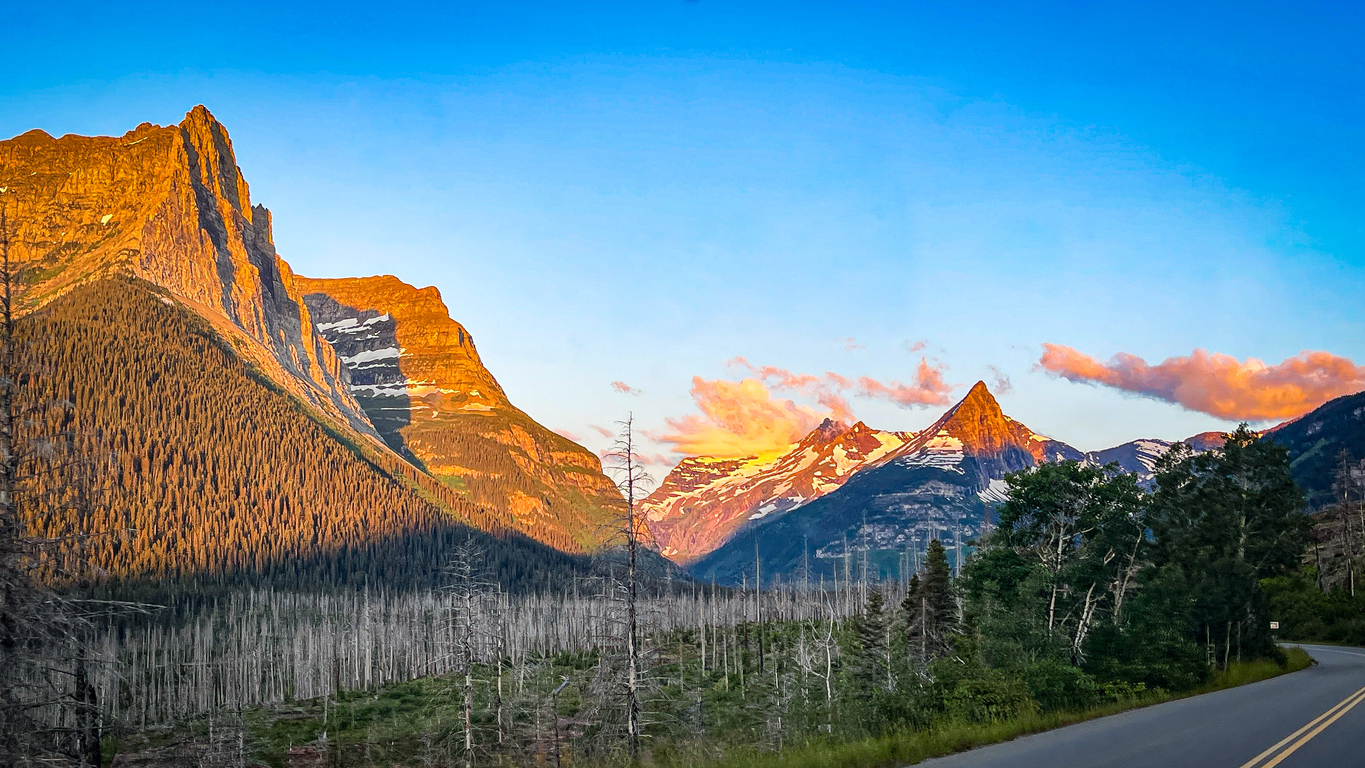
Driving Going-to-the-Sun Road at sunrise is a genuinely memorable experience. You’ll have Logan Pass almost entirely to yourself, the light is extraordinary on the peaks and lakes, and wildlife activity peaks in the first hour after dawn. Sunrise in Glacier in July is around 5:30–6:00 AM — plan to arrive at Logan Pass by 6 AM for the best light.
When Is Going-to-the-Sun Road Open?
The road doesn’t open all at once. Lower sections near West Glacier and St. Mary typically open in mid-April, but the full road over Logan Pass — the section most visitors come for — usually doesn’t open until late June or early July, depending on snowpack.
Typical opening timeline:
- West Glacier to Avalanche Creek: mid-April (weather permitting)
- Mary to Rising Sun: mid-April (weather permitting)
- Full road including Logan Pass: late June to early July
- Road closes for winter: October to November depending on snowfall
Always check the NPS Glacier road conditions page before you go — conditions change quickly, especially in early and late season.
Best months to visit:
- July–August — Full road open, wildflowers blooming at Logan Pass, most services available; busiest period
- Late June — Road just opened, snowfields visible, noticeably fewer crowds
- September — Larch trees turn golden, crowds drop significantly after Labor Day, wildlife very active
2026 Access: What You Need to Know
Good news for 2026: the vehicle reservation system that previously required timed-entry permits to drive Going-to-the-Sun Road has been eliminated. You can drive the road at any time during operating hours without booking in advance.
What still applies in 2026:
- Park entrance fee required — $35/vehicle or covered by the America the Beautiful annual pass
- Vehicle size restrictions — vehicles over 21 feet long or 8 feet wide are not permitted between Avalanche Creek and the Sun Point parking area
- Logan Pass 3-hour parking limit — starting July 1, 2026, vehicles may park at Logan Pass for a maximum of 3 hours
- Logan Pass Shuttle — now ticketed at $1/person (ages 2+); tickets via Recreation.gov; 60-day advance window; daily releases at 7 PM MDT starting June 30 for the following day
- Non-US residents — additional per-person fee applies unless entering with an Annual Pass or America the Beautiful Pass
The shuttle operates July 1 – September 7, 2026, departing from Apgar Visitor Center and Lake McDonald Lodge on the west side, and from St. Mary and Rising Sun on the east side. Book the evening before if possible — cell service inside the park is unreliable for day-of booking.
Vehicle Restrictions and RV Tips
The middle section of Going-to-the-Sun Road — between Avalanche Creek and the Sun Point parking area — has strict vehicle size limits. Vehicles over 21 feet long or 8 feet wide (including mirrors) are not allowed.
If you’re traveling in a larger RV or pulling a trailer, you can still access both ends of the road (West Glacier to Avalanche Creek on the west, and St. Mary to Sun Point on the east) and take the Logan Pass Shuttle for the middle section. This is a completely workable strategy that many RV travelers use every season.
What to Bring on Going-to-the-Sun Road
There are no services along the 33-mile stretch of road between Lake McDonald and Rising Sun. Come prepared:
- Water — bring more than you think you need, especially if hiking
- Food and snacks — pack a lunch; there’s a water station at Logan Pass but no food services on the road
- Layers — Logan Pass sits at 6,646 feet and is regularly 20–30°F colder than the valley; bring a jacket even in July
- Rain gear — weather can change quickly in the mountains
- Sunscreen and sunglasses — high elevation means intense UV exposure
- Binoculars — essential for wildlife and glacier viewing
- Bear spray — required if hiking; available at most outfitters in Whitefish and West Glacier
- Full tank of gas — fill up in Whitefish, Columbia Falls, or West Glacier before entering the park
- Park pass or entrance fee ($35/vehicle) — have it ready at the entrance gate
Driving the Full Loop: Going-to-the-Sun Road + Highway 2
Many visitors drive Going-to-the-Sun Road in one direction and return via US Highway 2 along the park’s southern border — creating a full loop of approximately 140 miles. This is a great option if you want to see both sides of the park and avoid retracing the same 50-mile route.
The Highway 2 return adds roughly 1.5–2 hours of driving through the Flathead Valley and the southern edge of the park. It passes through the towns of East Glacier and Essex, with several scenic stops of its own including views of Two Medicine Lake and access to the Goat Lick Overlook, where mountain goats gather to lick minerals from the exposed rock.
Full loop time estimate:
- Going-to-the-Sun Road (with stops): 4–8 hours depending on your plan
- Highway 2 return: 1.5–2 hours
- Total loop: 6–10 hours — a very full day from any western gateway town
FAQs: Going-to-the-Sun Road
How long does it take to drive Going-to-the-Sun Road without stops?
Without stopping, you can drive the full 50-mile route in approximately 2 hours. In practice, expect closer to 2.5–3 hours due to traffic, the road’s narrow and winding sections, and the occasional slow-moving vehicle ahead of you.
Is one day enough for Going-to-the-Sun Road?
One day is enough to drive the full road, stop at the main overlooks, spend meaningful time at Logan Pass, and have a picnic. It won’t be enough if you also want to hike multiple trails. For a first visit, a full day (6–8 hours) is the sweet spot — enough to feel like you’ve truly experienced the road without rushing.
Do I need a reservation to drive Going-to-the-Sun Road in 2026?
No. The vehicle reservation system has been eliminated for 2026. You can drive the road at any time without an advance permit. You still need a valid park entrance pass ($35/vehicle or the America the Beautiful annual pass).
What time does Logan Pass parking fill up?
During peak season (mid-July through August), Logan Pass parking typically fills by 9–9:30 AM. Arrive before 7:30 AM to reliably get a spot. If you miss the window, use the Logan Pass Shuttle ($1/person, ticketed via Recreation.gov) or wait for turnover in the afternoon — the new 3-hour parking limit (starting July 1, 2026) means spots open up more frequently than before.
Can I drive Going-to-the-Sun Road in an RV?
Not on the full road. Vehicles over 21 feet long or 8 feet wide cannot drive the middle section between Avalanche Creek and Sun Point. RV travelers can drive both ends of the road and use the Logan Pass Shuttle to see the alpine section.
What is the best direction to drive Going-to-the-Sun Road?
Both directions offer spectacular scenery. West to east (starting at West Glacier) puts you on the outside edge of the road as you climb to Logan Pass — some drivers find this more dramatic. East to west (starting at St. Mary) keeps you closer to the rock wall on the exposed alpine sections, which many visitors prefer if they’re nervous about the drop-offs. There’s no wrong answer.
Is Going-to-the-Sun Road free?
The road itself has no additional fee, but you must pay the Glacier National Park entrance fee to enter. As of 2025, this is $35 per vehicle. The America the Beautiful annual pass ($80) covers entrance to all US national parks and is worth it if you visit more than two or three parks per year.
Where to Stay for a Going-to-the-Sun Road Trip
Your lodging choice directly affects how much you can get out of Going-to-the-Sun Road. The earlier you can be on the road, the better your experience — and that means staying close.
Whitefish is the most popular base for the west side of the park, sitting about 25 miles from the West Glacier entrance. It has the best restaurants, amenities, and range of accommodations in the area. Columbia Falls and West Glacier are closer to the park entrance and work well if your priority is maximum time on the road.
For families and groups, a vacation rental gives you the flexibility hotels can’t match — a full kitchen to prep early-morning picnic lunches, extra space to spread out gear and layers, and a home base that fits the pace of a proper Glacier trip.
Explore Montana Rentals offers professionally managed vacation homes near Glacier National Park and Whitefish Mountain Resort. Whether you’re planning a sunrise drive or a multi-day park itinerary, browse our rentals near Glacier and find the right base for your trip.
Plan Your Time and Enjoy Every Mile
Going-to-the-Sun Road can be a 2-hour drive or a 10-hour adventure — both are valid and both are worthwhile. The key is knowing what you want from the day before you start, so you’re not rushing past the best parts or getting stuck in peak-hour traffic without a plan.
If it’s your first visit: give it a full day. Start early, bring layers and a packed lunch, leave your phone on airplane mode, and let the road do the rest.